Choosing the right lock for your home or business can feel overwhelming, with countless options and technical specifications to navigate. One crucial aspect often misunderstood is the ANSI grading system. These grades aren’t just arbitrary numbers; they are a standardized benchmark that dictates a lock’s durability, strength, and security. As a technician with over a decade of experience in smart lock technology, I’ve seen firsthand how these ratings translate to real-world protection. This article will demystify ANSI grades, break down what each level signifies, and help you determine if the top-tier Grade 1 security is truly necessary for your specific needs and budget. Let’s unlock the secrets to securing your space effectively.
What Are ANSI Grades for Locks?
The American National Standards Institute (ANSI), in conjunction with the Builders Hardware Manufacturers Association (BHMA), developed a comprehensive grading system to evaluate door hardware, including locks. This system provides a consistent and reliable method for comparing the performance and durability of products across different manufacturers. By setting rigorous criteria, ANSI/BHMA standards ensure that locks undergo extensive testing to verify their operational performance, resistance to forced entry, and long-term durability. These grades are essential for both consumers seeking peace of mind and professionals specifying hardware for commercial applications, ensuring that security solutions meet expected levels of functionality and protection.
Decoding Each ANSI Lock Grade: 1, 2, and 3
The ANSI grading system categorizes door locks into three distinct levels: Grade 1, Grade 2, and Grade 3. Each grade reflects increasing levels of security and durability, designed to meet varying demands from light residential use to heavy-duty commercial environments. Understanding the specifics of each grade is key to making an informed security decision.
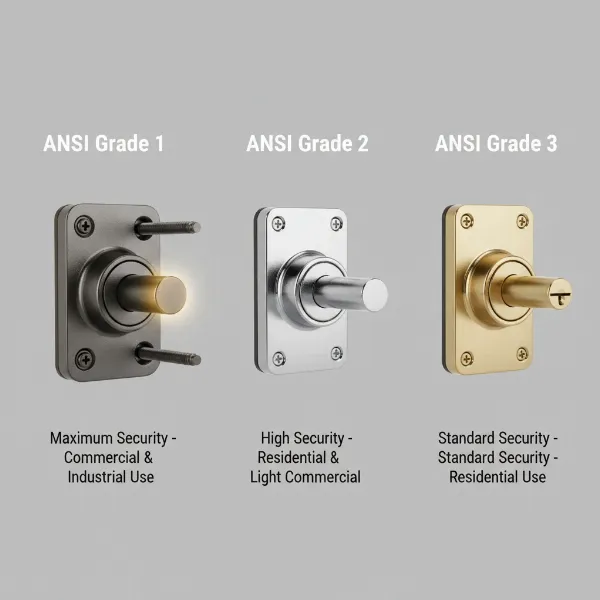 Visual comparison of ANSI lock grades: Grade 1, 2, and 3, highlighting differences in durability and security features.
ANSI Grade 1: The Apex of Security and Durability
ANSI Grade 1 represents the highest level of performance and security available in the United States. These locks are engineered for continuous, high-traffic operation and maximum protection. They are built with robust materials like solid brass, stainless steel, or cast metal components, making them highly resistant to wear, corrosion, and impact.
To earn a Grade 1 certification, locks must pass an array of demanding laboratory tests. For example, a Grade 1 deadbolt must withstand 250,000 opening and closing cycles and a “hammer test” of 10 door strikes, while Grade 1 door knobs must endure 800,000 cycles, 6 door strikes, and a 360-pound weight test. Their reinforced bolts, heavy-duty torque mechanisms, and often advanced features like anti-drill plates and hardened cylinders offer superior protection against brute force attacks, picking, and tampering.
- Ideal Applications:
- Commercial and industrial settings (e.g., hospitals, schools, government buildings, financial institutions, factories, warehouses).
- Main entry doors and high-security exterior doors.
- High-traffic areas requiring exceptional longevity and resistance to abuse.
|
Our Picks for the Best Smart Lock in 2026
As an Amazon Associate I earn from qualifying purchases.
|
||
| Num | Product | Action |
|---|---|---|
| 1 | TEEHO TE001 Keyless Entry Door Lock with Keypad - Smart Deadbolt Lock for Front Door with 2 Keys - Auto Lock - Easy Installation - Matte Black |

|
| 2 | Electronic Passwords Keyless Entry Door Locks Smart Deadbolt Metal Lock Auto Time Delay Locking Secure Durable Low Battery Alert Type-C Port for Emergency Charging |
|
| 3 | TEEHO TE001 Keyless Entry Door Lock with Keypad - Smart Deadbolt Lock for Front Door with 2 Keys - Auto Lock - Easy Installation - Satin Nickel |
|
| 4 | TEEHO TE001 Keyless Entry Door Lock with Keypad - Smart Deadbolt Lock for Front Door with 2 Keys - Auto Lock - Easy Installation - Oil-Rubbed Bronze |
|
| 5 | eufy Security Smart Lock C220, Fingerprint Keyless Entry Door Lock, Built-in Wi-Fi, App Remote Control, Front Door Smart Lock Deadbolt, 8Months Battery, Reliable Power, IP53 Waterproof, BHMA Grade 3 |
|
| 6 | eufy Security Smart Lock C220, Fingerprint Keyless Entry Door Lock, Built-in Wi-Fi, App Remote Control, Front Door Smart Deadbolt, IP53 Waterproof, 8-Months Battery, Nickel |
|
| 7 | Philips Wi-Fi Door Lock, WiFi Smart Lock Keyless Entry Deadbolt for Front Door, Remote Control, Built-in WiFi, APP Fingerprint Passcode Unlock, Auto Locking |
|
| 8 | ULTRALOQ U-Bolt Pro WiFi Smart Lock with Door Sensor, 8-in-1 Keyless Entry Door Lock with Fingerprint ID, App Remote Control, Built-in WiFi Keypad Deadbolt, Auto Unlock, IP65 Waterproof, Easy Install |
|
| 9 | Schlage Encode Smart WiFi Deadbolt Lock for Front Door - Keyless Entry with App or Touchscreen - Works with Alexa, Hey Google, & Airbnb - Create Codes for Guests - Matte Black |
|
| 10 | Philips Wi-Fi Door Lock, WiFi Smart Lock Keyless Entry Deadbolt for Front Door, Compatible with Alexa & Google Assistant, Remote Control, Built-in WiFi, APP Fingerprint Passcode Unlock, Auto Locking |
|
ANSI Grade 2: Reliable Security for Residential and Light Commercial Use
ANSI Grade 2 locks strike an excellent balance between security, durability, and affordability. They offer a significant upgrade over basic locks and are widely considered the best residential quality, also suitable for many light commercial applications. While not as robust as Grade 1, they provide reliable protection and durability for everyday use.
Grade 2 door knobs are typically tested to withstand 400,000 cycles, 4 door strikes, and a 250-pound weight test, while deadbolts must endure 150,000 cycles and a 5-door-strike hammer test. These specifications make Grade 2 locks a robust choice for environments that experience moderate traffic and require solid security without the extreme demands of commercial-grade environments.
- Ideal Applications:
- Most residential exterior doors (e.g., front, back, garage entry).
- Light commercial settings (e.g., interior office doors, exam rooms, apartments).
- Properties where a balance of robust security and cost-effectiveness is desired.
ANSI Grade 3: Basic Protection for Low-Risk Areas
ANSI Grade 3 represents the minimal acceptable quality for residential door locks, offering basic security and durability. These locks are the least expensive option and are designed for low-risk, low-traffic applications where high security isn’t the primary concern.
Grade 3 door knobs are typically tested to 200,000 cycles, 2 door strikes, and a 150-pound weight test. While they meet minimum safety standards, they may not withstand determined attempts at forced entry as effectively as higher-grade locks. For this reason, many locksmiths recommend upgrading to at least a Grade 2 lock for all exterior residential doors to ensure adequate protection.
- Ideal Applications:
- Residential interior doors (e.g., bedrooms, bathrooms, closets).
- Sheds or utility areas where security demands are minimal.
- Situations where cost is the overriding factor and security is not critical.
Is ANSI Grade 1 Always Necessary? Weighing Your Security Needs
The question of whether ANSI Grade 1 is “necessary” ultimately depends on your specific security requirements and environment. While Grade 1 locks offer the highest level of security and durability, they are often overkill—and an unnecessary expense—for many standard residential applications.
For most homes, a robust ANSI Grade 2 lock on exterior doors provides excellent security, balancing protection with practical cost. Grade 1 locks truly shine in high-traffic, high-risk commercial or institutional settings where thousands of cycles per day, potential for abuse, and the need for maximum deterrence against professional intruders are paramount. Consider a bustling school, a hospital corridor, or a government building; these environments undeniably demand the superior resilience of Grade 1 hardware.
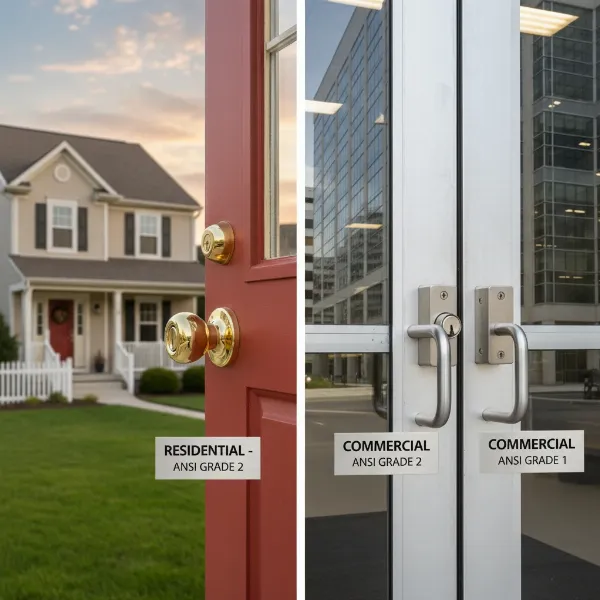 Comparison of lock grades applied to residential and commercial building types for security.
However, for a typical suburban home, the difference in security offered by a Grade 1 versus a Grade 2 deadbolt might not justify the increased cost, especially if other security measures like alarm systems or surveillance are also in place. It’s crucial to understand that ANSI grading primarily assesses mechanical durability and resistance to brute force. Features like pick resistance or advanced electronic security (common in smart locks) are often evaluated under separate standards, such as UL 437. Therefore, a Grade 1 mechanical lock doesn’t automatically mean it’s impervious to picking.
Choosing the Right ANSI Grade for Your Property
Selecting the appropriate ANSI grade for your door hardware is a critical decision that impacts the safety and security of your property. Rather than simply opting for the highest grade, consider a thoughtful assessment of your specific circumstances.
Assess Your Environment and Traffic
Start by evaluating where the lock will be installed. Is it a high-traffic main entry door for a commercial building, a moderate-use front door for a family home, or an interior door in a low-traffic office? High-humidity areas or locations exposed to harsh outdoor elements might also benefit from the robust construction of higher-grade locks, which are designed to withstand moisture and corrosion. The expected frequency of use and the environmental conditions are key factors in determining the necessary durability.
Define Your Security Requirements
Consider the level of security your property demands. Are you protecting valuable assets, sensitive information, or the safety of many people? For high-security environments like government buildings, banks, or properties in areas with high crime rates, Grade 1 locks provide unparalleled protection. For standard residential properties, Grade 2 locks offer reliable security that often exceeds basic homeowner needs. For interior doors or low-risk storage areas, Grade 3 can be a practical, cost-effective solution.
Consider Your Budget and Long-Term Value
While Grade 1 locks are the most expensive upfront, their superior durability can lead to lower long-term maintenance and replacement costs in high-wear situations. However, for applications where a Grade 2 lock is sufficient, opting for a Grade 1 might be an unnecessary expenditure. It’s about finding the sweet spot where security needs are met without overspending. Evaluate the balance between initial investment and the expected lifespan and performance in your specific context.
Don’t Forget Complementary Security Features
Remember that ANSI grades focus on the mechanical strength and durability of the lock. For comprehensive security, especially with smart locks, also consider features like pick resistance (often indicated by UL 437 certification), key control, advanced encryption for smart lock communication, and integration with home security systems. A high ANSI grade lock combined with smart technology features can offer a truly formidable defense.
“The highest ANSI grade isn’t always the ‘best’ lock for everyone. The best lock is the one that perfectly matches your property’s unique security profile, traffic patterns, and budget, providing optimal protection where it matters most.” – [Your Name/Title], Smart Lock Expert
Conclusion
Understanding ANSI grades is fundamental to making informed decisions about your door hardware. From the heavy-duty resilience of Grade 1, designed for commercial fortresses, to the dependable security of Grade 2 for most homes, and the basic functionality of Grade 3 for internal doors, each grade serves a distinct purpose. It’s clear that while Grade 1 offers the pinnacle of durability and security, it isn’t always the necessary or most cost-effective solution for every situation. By carefully assessing your specific environment, traffic, security needs, and budget, you can confidently choose a lock that provides optimal protection without over-investing.
Which ANSI grade do you believe is the perfect fit for your property’s security strategy?
Frequently Asked Questions
What does ANSI Grade 1 mean on a lock?
ANSI Grade 1 is the highest performance rating under ANSI/BHMA standards, indicating a lock that has passed over 1 million operating cycles and meets the toughest tests for strength, durability, and security. It is typically used on commercial and institutional doors that see heavy daily use and require maximum protection.
Are Grade 1 locks more pick resistant?
While Grade 1 locks are inherently more robust against brute force attacks, the ANSI grading system primarily focuses on mechanical durability and strength, not necessarily pick resistance. Pick resistance is often evaluated under separate security standards, such as UL 437. Some Grade 1 locks may incorporate pick-resistant features, but the grade itself doesn’t guarantee it.
Can I use a Grade 3 lock on my front door?
While a Grade 3 lock meets minimum safety standards, it is generally not recommended for exterior doors, especially main entry points, due to its basic level of security and durability. Most experts advise using at least an ANSI Grade 2 lock for all residential exterior doors to ensure adequate protection against forced entry.
How can I tell the ANSI grade of my lock?
Look for markings on the lock or its packaging, such as “ANSI/BHMA Grade 1 Certified” or references to specific ANSI standards like A156.2 or A156.13. Many products also carry BHMA or UL certification labels, which confirm independent testing and grading. If unsure, check the manufacturer’s specifications.
